

Predicting the future always carries risk, but some trajectories are visible enough to talk about with genuine confidence. AI’s current trajectory in online game development points toward a next era defined less by any single breakthrough and more by the compounding effect of several shifts already underway, faster iteration, broader access, and games that respond more intelligently to the people actually playing them.
What the Current Trajectory Suggests
Speed Gains Keep Compounding
Each improvement in how quickly an idea becomes testable doesn’t just help the project it’s applied to, it changes what becomes realistic for every project after it. A developer who can iterate faster today carries that capability into everything they build going forward, which means the cumulative effect of speed improvements keeps growing rather than leveling off.
Access Keeps Broadening
The technical barrier that used to gate who could build a game has already dropped substantially, and there’s no clear mechanism by which it would rise again. If anything, continued improvement in natural language tools suggests that barrier keeps shrinking further, bringing in an even wider range of creators than the current shift has already enabled.
Where This Points for Game Design Itself
Games That Adapt More Intelligently to Players
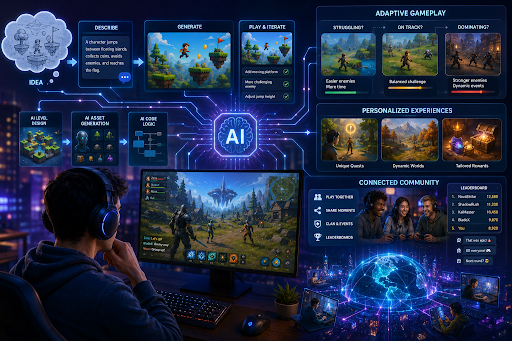
Beyond just helping build games faster, AI is likely to play a growing role within games themselves, adjusting difficulty in real time based on how a specific player is performing, rather than relying on fixed difficulty settings decided in advance. A game like 99 Nights: Pokemon Edition hints at what’s possible when a familiar structure gets reimagined with room for that kind of responsive design, systems that feel less like a fixed experience and more like one that could genuinely adjust to the player engaging with it.
More Personalized Content Within Shared Games
Online games built for large player bases may increasingly generate variations in content, layouts, challenges, cosmetic elements, tailored to individual players rather than delivering identical experiences to everyone. This shift would let a single game feel fresh across a much wider range of players than static, one-size-fits-all content ever could.
Faster Response to Community Feedback
As AI-assisted development continues compressing the time between an idea and a testable version, online games are likely to update and respond to player feedback on much shorter cycles than the traditional patch schedules of the past, treating live games more like continuously iterated products than fixed releases with occasional updates.
How Development Itself Is Likely to Keep Evolving
From Planning-Heavy to Testing-Heavy by Default
As the cost of testing an idea keeps dropping, design processes are likely to lean even further into building rough versions quickly and learning from real play, rather than relying primarily on upfront planning and assumption. This isn’t a dramatic break from where things already are, it’s a continuation of a shift that’s already well underway.
Smaller Teams Producing at Increasingly Larger Scale
The production gap between what a small team and a large studio can achieve has already narrowed considerably. As game builder platforms continue to mature, that gap seems likely to keep closing, suggesting a future where team size matters less for what’s achievable and design sensibility matters more for what actually resonates with players.
Feedback Loops Becoming Nearly Continuous
The distance between having an idea and testing it has already shrunk from months to hours for many creators. Continued improvement in these tools suggests that distance could shrink further still, pushing development toward something closer to continuous iteration rather than distinct, separate phases of planning, building, and testing.
What’s Likely to Remain Constant, Even as Tools Advance
The Need for Genuine Creative Vision
No matter how sophisticated AI-assisted tools become, they execute described ideas rather than generating the underlying reason a specific concept is worth pursuing. That creative spark is likely to remain an entirely human contribution regardless of how far these tools advance.
Human Judgment About What Actually Feels Good
Faster tools and more responsive systems don’t remove the need for someone to decide whether a specific experience is genuinely satisfying. That evaluative judgment, watching real players and interpreting what their reactions mean, seems likely to stay a fundamentally human responsibility.
Taste as the Ultimate Differentiator
As execution and even some adaptive intelligence become more broadly accessible, what continues to separate a genuinely great online game from a merely functional one is likely to depend increasingly on the taste and judgment of whoever is directing its design, not on the sophistication of the underlying tools.
Challenges the Next Era Will Likely Still Need to Address
Standing Out Amid Growing Volume
As more creators gain access to fast, capable development tools, the sheer number of online games competing for player attention is likely to keep growing. Helping genuinely good games stand out within that increasing volume is a challenge that faster development alone doesn’t solve.
Maintaining Meaningful Human Connection in Social Features
As games become more adaptive and personalized, there’s a real question about whether that personalization enhances genuine social connection between players or gradually erodes the shared, common experience that made multiplayer and social games compelling in the first place. How that balance gets struck will likely shape a lot about what the next era of online games actually feels like to play.
Final Thoughts
The next era of online games shaped by artificial intelligence is likely to be defined less by any single dramatic breakthrough and more by the compounding effect of trends already clearly underway: faster iteration, broader access to development, and games that respond more intelligently to the people actually playing them.
What seems unlikely to change, even as these tools continue advancing, is the centrality of genuine human creative judgment. AI is poised to keep expanding what’s possible technically, but deciding what’s actually worth building, and recognizing when something genuinely works, remains a distinctly human undertaking, and that’s likely to stay true no matter how far this next era goes.