

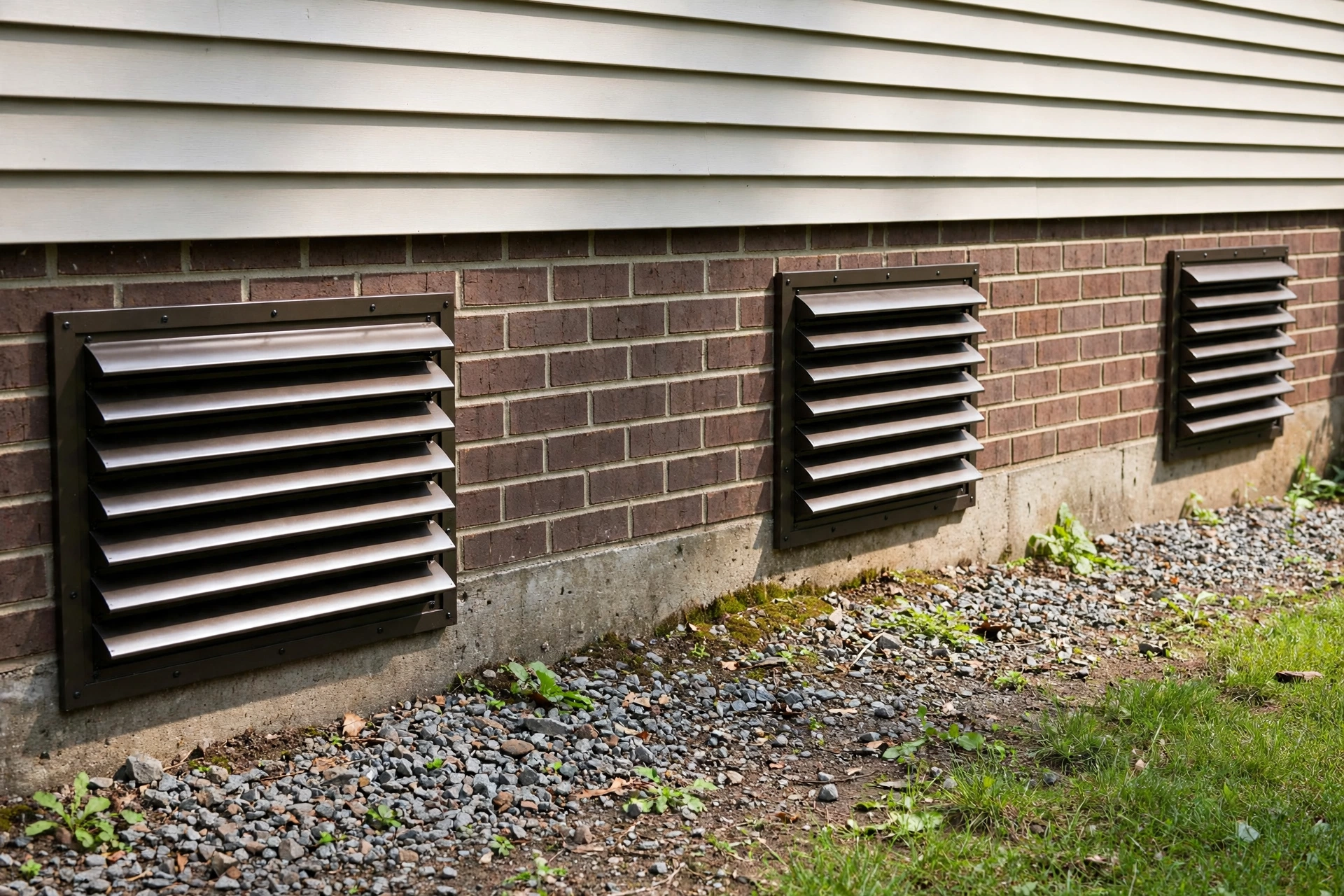
An adjustable foundation ventilation system gives a homeowner control over the air moving through the crawl space beneath the house, so the space can be opened to dry out in the right season and closed when outside air would make things wetter or colder. Fixed vents cannot do this: they admit humid summer air that condenses on cool joists, and they admit freezing winter air that threatens pipes. Adjustable vents — manual dampers, temperature-activated automatic vents, humidity-controlled units and powered fans — let the crawl space follow the seasons instead of fighting them.
This guide explains how ground moisture actually behaves under a house, compares the main types of adjustable vent, and walks through sizing, placement and installation in an existing foundation wall. It also covers the season-by-season adjustment calendar, the humidity readings that tell you whether to open or close, and the point at which ventilation stops being the answer and encapsulation begins.
Manual, Automatic and Powered Vents at a Glance
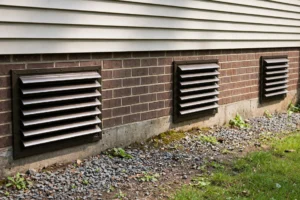
Adjustable foundation vents fall into four broad types, and the right choice depends on climate, budget and how much attention the homeowner is willing to give the system. Manual vents are the simplest and cheapest: a louvred grille with a sliding damper that the homeowner opens and closes by hand each season. Automatic vents use a temperature-sensitive element, usually a bimetallic strip, to open when it is warm and close when it is cold, with common set points around 70°F to open and 40°F to close. Humidity-controlled vents add a humidistat that opens only when outside air is drier than crawl space air. Powered vents use a fan to move air actively and are controlled by a humidistat or timer.
| Vent type | How it adjusts | Typical cost per vent | Best suited to |
|---|---|---|---|
| Manual damper vent | Opened and closed by hand each season | Lowest cost | Attentive owners in mild climates |
| Temperature automatic vent | Opens near 70°F, closes near 40°F | Roughly $30–$60 each | Cold winters, low humidity summers |
| Humidity automatic vent | Opens when outside air is drier than inside | Mid-range | Humid climates with variable weather |
| Powered fan vent | Fan exhausts on humidistat control | $300–$800 installed per system | Tight crawl spaces, poor natural airflow |
| Smart vent with sensors | App or controller manages open and close | Highest cost | Owners who want data and remote control |
Cost figures here are broad estimates only, and installation costs vary widely by region and by the condition of the foundation wall. The important comparison is not the price of one vent but the cost of getting the decision wrong: a vent left open through a humid summer can cause condensation, mould and wood rot that cost far more to repair than any vent ever saved. That is why the adjustment calendar matters as much as the hardware.
How Seasonal Ground Moisture Moves Under a House
Ground moisture is not constant. In spring, the soil is wet from winter rain and snowmelt, and moisture rises steadily into the crawl space as the ground warms. In summer, the problem reverses in humid climates: warm, moisture-laden outside air enters through open vents, hits the cooler crawl space, and its relative humidity spikes as it cools — often past the dew point, so water condenses directly onto joists, ducts and the underside of the floor. In autumn, dry days offer a chance to air the space out before winter. In winter, cold air through open vents can freeze exposed pipes and chill the floor above.
The traditional advice to "open vents in summer, close them in winter" is therefore only half right, and in humid climates it is actively wrong for summer. Research over the past two decades has shown that in most mixed and humid climates, outdoor summer air is more humid than the sealed crawl space, so venting in summer imports moisture rather than removing it. That finding, supported by building science researchers and energy departments, is why many professionals now recommend keeping vents closed through humid summers and considering encapsulation instead. The seasonal calendar in this guide reflects that updated understanding rather than the older rule of thumb.
Sizing and Placing Vents for Cross-Ventilation
Vents work as a system, not as individual holes. They must be distributed evenly around the foundation, with openings on opposing walls so air can flow across the space rather than in and out of the same side. The long-standing code reference in the United States, IRC R408.1, calls for about 1 square foot of vent area for every 150 square feet of crawl space floor where no ground vapour barrier is present, and that ratio relaxes to roughly 1:1,500 where a continuous vapour barrier covers the soil. Local codes vary, so treat those figures as a starting point and confirm the requirement with the local building department before cutting new openings.
- Place vents near corners on opposing walls. Corner placement with openings on opposite sides creates genuine cross-ventilation.
- Keep vents 6–12 inches above exterior grade. Lower vents invite splashback and surface water; higher vents still ventilate well.
- Never block a vent with stored material. Boxes, insulation offcuts and stored timber against a vent silently disable it.
- Fit a mesh screen behind every grille. Screens keep out rodents and large insects while letting air through.
Before installing any new vent, confirm that the foundation wall can accept it. Cutting an opening in a poured concrete wall is a different job from fitting a vent into a block wall or a timber-framed dwarf wall, and in some older homes the wall may be carrying loads that a new opening would disturb. If the wall shows cracking, bowing or previous repairs, get a structural opinion before cutting. The vent itself is cheap; the wall it sits in is not.
A Season-by-Season Adjustment Calendar
The calendar below is written for a mixed or humid climate, which covers most homes that struggle with crawl space moisture. In very dry climates the summer advice reverses, because dry outside air genuinely dries the space, and in very cold climates winter closure matters more than anything else. Adjust the calendar to your climate zone, and let the hygrometer readings override the calendar whenever they disagree.
| Season | Vent position | Reason |
|---|---|---|
| Spring | Open on dry days once the dew point falls | Dry out winter moisture accumulation |
| Summer (humid) | Keep closed | Humid outside air causes condensation inside |
| Summer (dry climate) | Open for cross-ventilation | Dry air genuinely dries the space |
| Autumn | Open on dry days | Air the space before winter closure |
| Winter | Closed | Protect pipes from freezing and keep floors warm |
The single most useful habit is a monthly check rather than a seasonal guess. Walk the crawl space entrance, look at the hygrometer, and note the reading and the vent position in a small log. Over a year that log shows exactly which months the space runs wet, and the calendar can then be tuned to the house rather than to a generic rule. A homeowner who checks monthly will catch a problem in weeks; one who checks annually may catch it after a joist has rotted.
Installing Adjustable Vents in an Existing Foundation Wall
Installation is straightforward when the opening already exists, which is the case for most retrofits: the old fixed grille comes out and the adjustable unit goes into the same opening. Measure the opening carefully before ordering, because foundation vent sizes are not fully standardised and a unit that is a few millimetres too large will not fit without cutting, while one that is too small will leak air around its edges. Check that the new unit includes a screen, a damper or control element, and a frame that can be sealed to the wall.
- Remove the old grille and clean the opening. Scrape off old sealant and check the opening edges for damage or damp.
- Dry-fit the new vent before sealing. Confirm it sits square and the damper moves freely through its full range.
- Seal the frame to the wall. Use a suitable exterior sealant so air passes through the vent, not around it.
- Fit the screen and test the damper. Manual dampers should slide smoothly; automatic vents should move as temperature changes.
- Label each vent with its setting. A small tag noting the season and position saves confusion at the next adjustment.
If a new opening must be cut, treat it as a structural job rather than a drilling job. Mark the opening, check for reinforcement, pipes and cables in the wall, and use the right cutting tools for the material — a core drill or angle grinder for concrete and block, a reciprocating saw for timber. Wear eye and dust protection, and have a second person nearby when working in a confined crawl space. If the wall is load-bearing and the opening is large, a lintel above the opening may be required, and that is a job for a professional.
Humidity Readings That Tell You Whether to Open or Close
A hygrometer in the crawl space turns vent adjustment from guesswork into a decision. The target is to keep relative humidity below 60%, because mould growth becomes likely above roughly 70% and wood decay accelerates as moisture content rises. Take readings at the same time of day and in the same spot, ideally near the centre of the space and away from the vents themselves, so the numbers are comparable. If the reading is climbing while the vents are open, close them and re-check in a few days; if it is climbing while they are closed, the moisture source is probably the soil, and a vapour barrier or dehumidifier is the next step.
A data-logging hygrometer is worth its small cost for a problem crawl space, because it records humidity and temperature around the clock and shows the pattern that spot readings miss. A log that shows humidity spiking every afternoon in summer points to open vents admitting humid air; a log that shows a steady climb regardless of vent position points to ground moisture; a log that spikes after rain points to water entry. Each pattern has a different fix, and the logger is what separates them.
Where Ventilation Stops and Encapsulation Begins
There comes a point where no vent adjustment solves the problem, and recognising it saves money. If the crawl space stays above 60% humidity with the vents closed, if the ground is bare soil with no vapour barrier, if there is standing water after rain, or if mould returns after cleaning, the space needs more than ventilation. Encapsulation — sealing the vents permanently, laying a heavy reinforced polyethylene vapour barrier over the ground and up the walls, and controlling humidity with a dehumidifier — is the approach now recommended by building science researchers and energy departments for most mixed and humid climates.
Encapsulation is a bigger investment than a set of adjustable vents, and it should be quoted by a specialist who can assess drainage, radon and combustion appliance safety before sealing the space. Do not seal vents and install a vapour barrier while a water entry problem is unresolved, because trapped water behind a barrier is worse than an open vent. Fix drainage first, then encapsulate, and keep the hygrometer in place afterwards so the new system can prove it is working.
Foundation Ventilation Questions, Answered for Homeowners
Should crawl space vents be open or closed in summer?
In humid climates, closed. Warm outside air entering a cooler crawl space drops in temperature, its relative humidity rises sharply, and water condenses on joists and ducts. In dry climates, open vents genuinely help because the outside air is drier than the space. Let the hygrometer decide: if humidity rises with vents open, close them.
How many foundation vents does a house need?
A common code reference is about 1 square foot of vent area per 150 square feet of crawl space floor without a vapour barrier, relaxing to roughly 1:1,500 with a continuous barrier. Vents should be spread evenly on opposing walls for cross-ventilation. Local codes vary, so confirm the requirement before cutting new openings.
Are automatic foundation vents worth the cost?
For owners who forget seasonal adjustments, yes. A temperature-activated vent opens near 70°F and closes near 40°F, which protects pipes in winter without any attention. Humidity-controlled vents are better in variable climates because they respond to moisture rather than temperature alone. Either type costs roughly $30–$60 per vent and fits the same opening as a standard grille.
Can I seal my crawl space vents permanently?
Yes, as part of encapsulation, but not on its own. Sealing vents without a vapour barrier and humidity control traps ground moisture inside the space and makes conditions worse. Encapsulation means sealed vents, a continuous reinforced barrier over the soil and walls, and a dehumidifier keeping humidity below 60%.
Why is my crawl space damp even with the vents open?
Because open vents admit humid outside air in summer, or because the moisture is coming from the soil rather than the air. If readings stay high with vents open, close them and re-check; if they stay high with vents closed, the source is ground moisture, and a vapour barrier or dehumidifier is needed rather than more ventilation.
Final Thoughts: Vents That Follow the Seasons, Not the Calendar
Adjustable foundation vents earn their keep when they are used as a control system rather than a set-and-forget fitting. Size them for cross-ventilation, place them on opposing walls, and then manage them by the hygrometer and the season: open to dry the space in spring and autumn, closed against humid summer air and freezing winter air. If the readings stay high no matter what the vents do, stop adjusting and start looking at vapour barriers and encapsulation, because the problem has moved beyond ventilation. A crawl space that stays dry protects the whole house above it, and that is worth a monthly check.